Contact center automation uses software (self-service, conversational AI, browser and document agents, and desktop automation) to handle or assist with contacts and back-office tasks that people used to do by hand. Done well, it removes predictable tier-one volume, shortens handle time on the rest, and frees agents for complex work. The first thing to automate is high-volume, deterministic contacts with clean answers, such as status checks, eligibility lookups, and simple scheduling. McKinsey frames the task as finding the right mix of humans and AI, with automation resolving a meaningful share of routine requests so people handle the hard ones. This guide sequences the work: what to automate first, how to measure ROI, and how to roll it out.
What is contact-center automation?
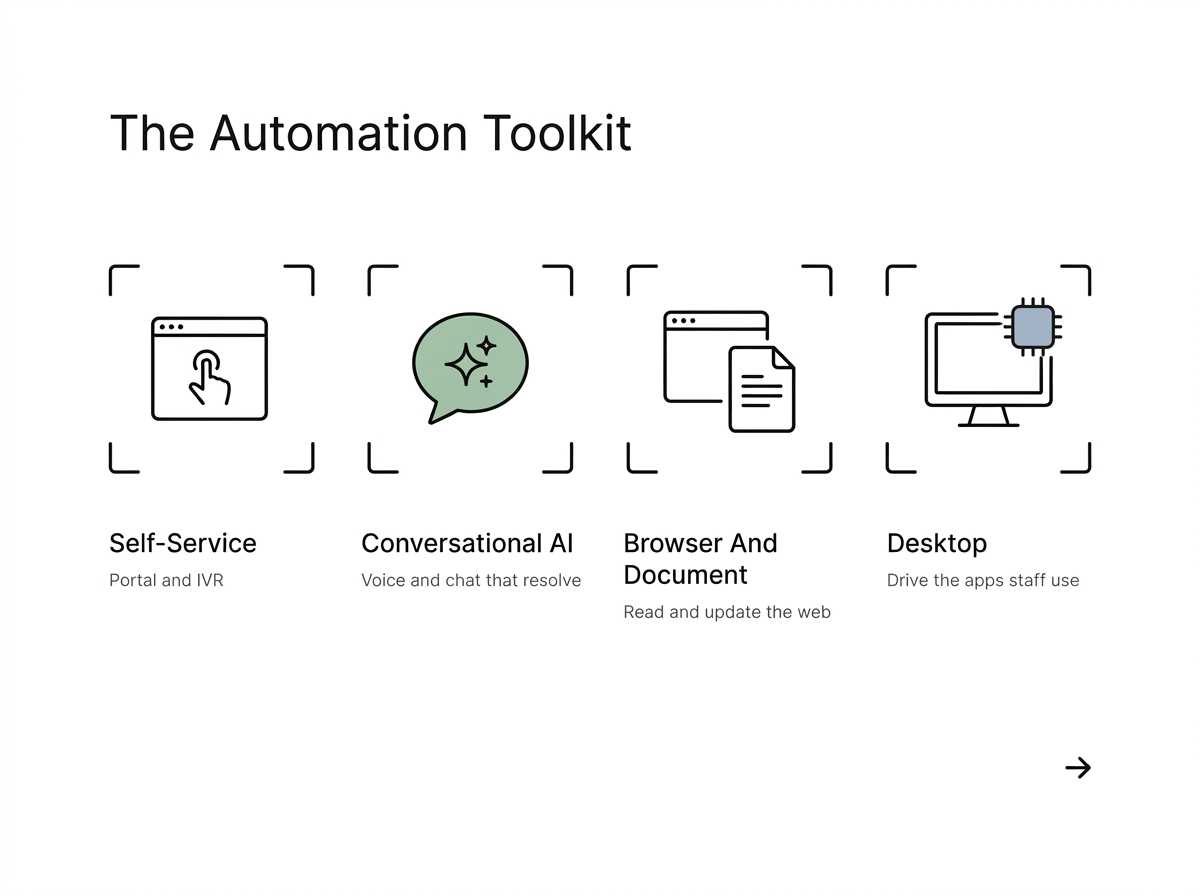
Contact-center automation is any technology that completes a contact task without a human doing every step. It spans self-service (deflecting simple requests to a portal or IVR), conversational AI (voice and chat agents that resolve issues end to end), and back-office automation (browser, document, and desktop agents that update systems). Document360 reports that roughly 67 percent of customers prefer to solve simple issues themselves, which is why self-service is usually the entry point. The important distinction is between deflection and resolution. Deflection just moves a contact off the phone; resolution actually finishes the job. Automation that deflects without resolving pushes a frustrated customer to a harder agent call later, so the target is resolution across cross-vertical queues in BPO, insurance, healthcare, and public sector alike.
Want this mapped against your own call and claim volume? Book a 30-minute audit
What should you automate first?
Automate the contacts that are high-volume, repetitive, and deterministic before anything ambiguous or emotional. Rank your contact types by volume times handle time to find the biggest blocks, then filter for the ones with a single correct answer: order and claim status, eligibility and benefits checks, appointment scheduling and reminders, password resets, and address changes. Deloitte Digital reports that process automation is a top priority for customer-experience leaders, and that early adopters see gains in deflection to self-service and agent productivity. Leave nuanced, high-emotion, or exception-heavy contacts for humans, at least at first. Related building blocks are worth measuring on their own: IVR containment tracks how much you deflect cleanly, and after-call work is often the fastest documentation task to automate.
The answer comes from the calls, not from a vendor's list: the first candidates are the high-volume call types that follow a script. Flexbone finds them by transcribing and classifying a center's calls before building anything, the method set out in audit then automate.
See what AI can run at your facility. In a 30-minute audit we map the calls, eligibility, and follow-ups Flexbone can take off your team first.
Book an auditHow do you measure ROI?
Measure automation ROI on resolution and cost per contact, not on deflection alone. The numerator is the fully loaded cost you remove: agent-minutes saved times your loaded rate, plus reduced repeat contacts. The Bureau of Labor Statistics put the median wage for customer service representatives at about $43,500 in its May 2023 data, a useful baseline for the loaded agent rate in that calculation BLS. The denominator is what automation costs to build and run. Gartner projected conversational AI would cut contact-center agent labor costs by 80 billion dollars in 2026, a figure that only lands if automation resolves rather than merely deflects. Track four numbers per automated contact type: containment or automated-resolution rate, cost per contact, first call resolution on the residual human calls, and CSAT. Use our cost per contact calculator and staffing calculator to model the before and after. If CSAT or resolution drops, the ROI is not real, no matter how high the deflection rate looks.
How do you roll it out?
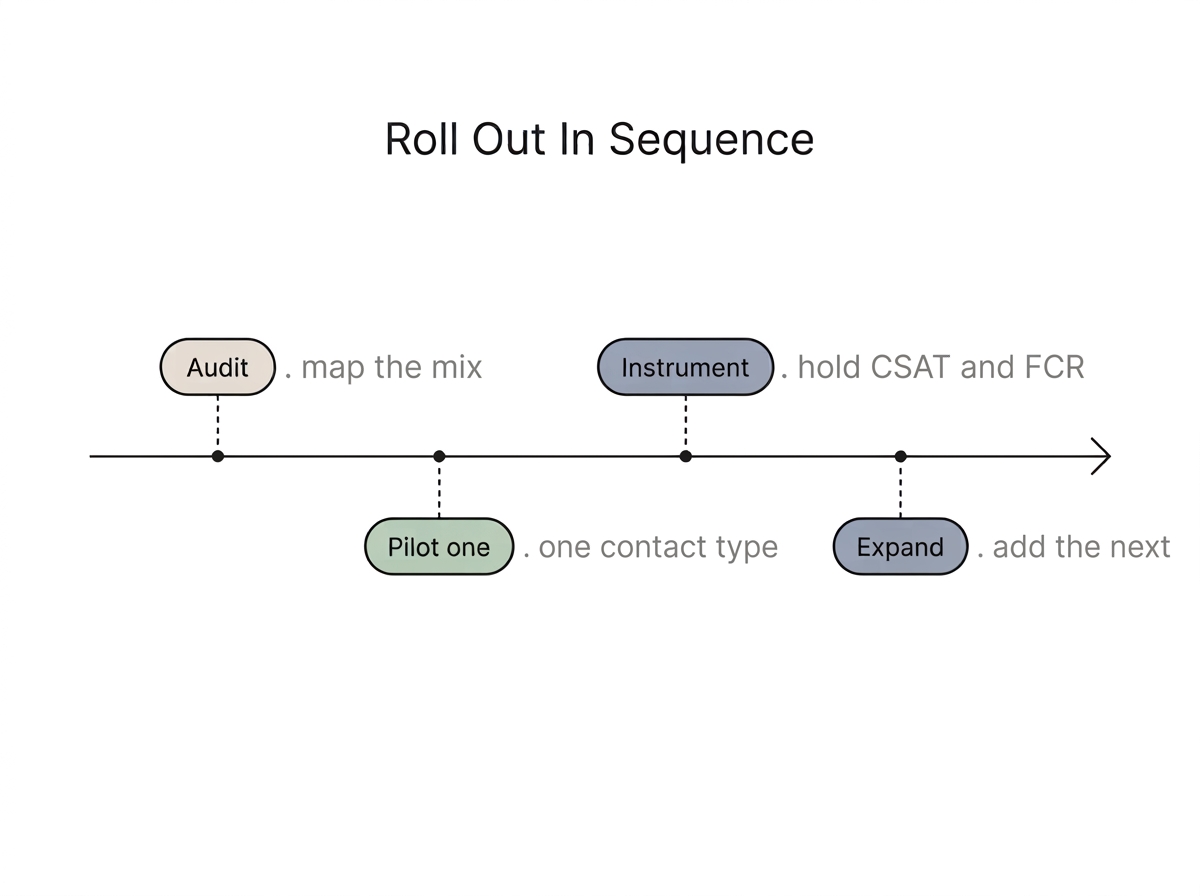
Roll out in sequence: audit, pilot one contact type, instrument, then expand. Start with an audit of your contact mix so you automate from evidence, not from a vendor demo. Pilot a single high-volume, deterministic contact type with a clean escalation path to a human, and hold CSAT and first call resolution as guardrails. McKinsey estimates generative AI could raise customer-care productivity by 30 to 45 percent of current cost, but that upside depends on disciplined scoping and change management rather than a big-bang launch. As you expand, redeploy freed capacity into coaching and complex work to protect against agent burnout, and re-baseline handle-time targets for the harder residual mix. Each contact type you add makes the next one easier to scope.
How Flexbone sequences your automation roadmap
Flexbone builds audit-first AI agents (voice, browser, document, and desktop) that automate contact-center and back-office work in secure, regulated environments. We lead with the audit because the roadmap above only works when you automate the right contact types in the right order, measured on resolution and cost per contact rather than raw deflection. The platform is HIPAA compliant and SOC 2-aligned, so BPO, insurance, healthcare, and public-sector teams can sequence automation without new compliance risk. Start with one high-volume contact type, prove the numbers on a pilot, then expand along the roadmap.
Start a pilot: https://www.flexbone.ai/contact